Photograph of Acanthops falcata by Steven Potter. See his photographs here!
Acanthops falcata
South American Deadleaf Mantis
Taxonomy;
Class: Insecta
Order: Mantodea
Family:Acanthopidae
Genus: Acanthops
Species: falcata
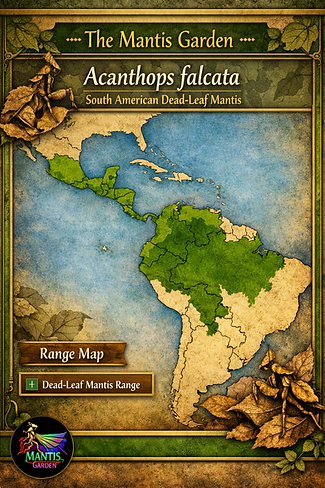
🌎 Lowland Forests of Central & South America
The Neotropical World That Shapes Acanthops falcata
🌿 Habitat
Acanthops falcata inhabits the warm, humid lowland forests stretching across Central and South America — a region defined by dense understory growth, sprawling leaf litter, and a canopy that filters sunlight into soft, shifting greens. These forests are layered, textured, and alive with movement, creating the perfect stage for a mantis that specialises in disappearing in plain sight.
🍂 A Master of Leaf Mimicry
This species doesn’t just live in the neotropics — it becomes part of them. Acanthops falcata’s entire body plan is shaped by the forest floor: jagged leaf‑like lobes, muted earthy tones, and a posture that mimics a dead leaf caught mid‑fall. In an environment full of drifting debris and dappled shadows, this cryptic predator blends seamlessly into the background, waiting motionless until prey wanders too close.
💧 Climate
The lowland forests are consistently warm and saturated with moisture. Daily rainfall, heavy dew, and thick humidity create a stable microclimate where leaf litter stays damp and the air rarely dries out. This high‑humidity environment suits Acanthops falcata perfectly, supporting its behaviour, hydration, and moulting needs.
🕵️ Behaviour & Predation
Acanthops falcata relies on stillness, camouflage, and patience. Perched among fallen leaves or clinging to bark, it uses its uncanny mimicry to vanish into the forest’s natural clutter. When prey approaches, the strike is sudden and precise — a perfect example of cryptic predation shaped by millions of years in the neotropical understory.
🌱 Why This Matters in Captivity
To help this species feel at home, aim to recreate the essence of these forests:
-
High humidity with gentle airflow
-
Warm, stable temperatures
-
Leaf‑litter textures and natural décor
-
Soft, filtered lighting rather than harsh brightness
When the environment echoes its native lowland forests, Acanthops falcata displays its full range of natural behaviours — confident, camouflaged, and beautifully adapted.
🪵 Appearance of Acanthops falcata
The Original Dead‑Leaf Illusionist
📜 First Described
Acanthops falcata was first formally described by Jean Guillaume Audinet‑Serville in 1831, placing it among the earliest recognised masters of leaf mimicry in the Mantodea order.
🍂 Overall Appearance
Acanthops falcata is a sculpted tribute to the forest floor—every edge, lobe, and contour shaped to resemble a curled, desiccated leaf. Its body is textured with jagged margins, uneven surfaces, and earthy tones ranging from pale beige to deep bark‑brown. Even when motionless, it looks like a leaf caught mid‑decay, complete with “torn” edges and a posture that mimics a leaf hanging by its last fibres
♀️ Females — The Heavyweight Leaf
🌰 Robust, sculpted, and unmistakably leaf‑like
-
Stockier build with a broad, flattened thorax that enhances the dead‑leaf silhouette.
-
Large, ornate leaf lobes on the legs and abdomen, giving a dramatic, curled‑leaf profile.
-
Shorter wings that do not fully cover the abdomen, adding to the illusion of layered leaf litter.
-
Earthy, matte colours that blend seamlessly with bark and forest debris.
-
Behaviourally more static, relying heavily on camouflage rather than mobility.
Females look like a curled, brittle leaf that’s been stepped on once and given up on life—perfect for vanishing into the neotropical understory.
♂️ Males — The Agile Leaf Shard
🍃 Slimmer, lighter, and built for movement
-
More slender body with a narrower thorax and reduced leaf lobes.
-
Fully developed wings that extend past the abdomen, enabling controlled flight.
-
More delicate leaf mimicry, resembling a thin, curled leaf fragment rather than a full dead leaf.
-
Longer antennae and a more alert posture, reflecting their need to roam in search of females.
-
Smoother, slightly glossier tones, often with subtle patterning.
Males look like a lighter, wind‑tossed leaf shard—still cryptic, but built for mobility rather than bulk camouflage
🔍 At a Glance: Male vs Female
-
Females: Broad, heavy, ornate, short‑winged, intensely leaf‑like.
-
Males: Slim, long‑winged, agile, lightly ornamented.
Both are masterpieces of mimicry, but each expresses the “dead leaf” illusion in its own evolutionary style.
🍽️ Feeding Behaviour — Wild & Captive
Acanthops falcata, the patient leaf that strikes like a trapdoor
🌳 In the Wild — The Ambush Artist
🍂 Camouflage as a weapon
Acanthops falcata is a pure ambush predator, relying almost entirely on its dead‑leaf disguise to lure prey into striking distance. Perched among leaf litter or clinging to bark, it becomes visually indistinguishable from the debris around it. This camouflage isn’t just defensive — it’s an active hunting tool.
-
Total stillness until prey wanders close
-
Slow, rhythmic leaf‑swaying to maintain the illusion
-
Lightning‑fast strike once the target enters range
In the neotropical understory, this strategy is brutally effective. Small flies, beetles, and wandering invertebrates simply don’t realise the “leaf” beside them has eyes.
🪲 In Captivity — Surprisingly Food‑Aggressive
⚡ A calm leaf until food appears
Despite their quiet, cryptic nature, Acanthops falcata are shockingly food‑responsive once they recognise movement. When prey is introduced, the transformation is instant: the still, brittle “leaf” becomes a focused predator.
-
Fast, decisive strikes at anything appropriately sized
-
Strong feeding response even in juveniles
-
Confident grab-and-hold behaviour, especially in females
-
Excellent accuracy, even when partially hidden in décor
Females, being heavier and more robust, often show the strongest feeding aggression, while males are slightly more cautious but still reliable feeders.
👁️ How Camouflage Shapes Their Feeding Style
🕵️ Invisible until it’s too late
Their mimicry isn’t just for show — it dictates how they hunt:
-
They wait for prey to come to them, conserving energy.
-
Their jagged leaf lobes break up their outline, making the strike unpredictable.
-
They often angle their bodies like a curled leaf, hiding the raptorial arms until the final moment.
-
Even during the strike, their colours and textures keep them visually “lost” in the background.
This combination of patience, disguise, and explosive movement makes Acanthops falcata one of the most efficient cryptic predators in the hobby.
🧩 Keeper Notes
-
They feed well on flies, small roaches, and other active prey.
-
Their feeding aggression makes them easy to maintain, despite their delicate appearance.
-
Avoid overly large or jumpy prey — their hunting style favours controlled, close‑range movement.
🍽️ Feeding & Understanding Hunger in Praying Mantises
A body‑condition approach to feeding — not a schedule
🌡️ Temperature Drives Appetite
Praying mantises do not operate on a human‑style feeding timetable. Their metabolism rises and falls with temperature, meaning their hunger levels shift naturally with the environment. Warmer conditions accelerate digestion; cooler conditions slow everything down. Because of this, the only intelligent way to judge when to feed is by reading the abdomen, not the calendar.
👀 Assessing Hunger by Abdomen Shape
🍃 Flat-bodied = ready to eat
A mantis with a flat, streamlined abdomen is ready for a meal. This is your green light.
🚫 Visible membrane = full
If you can clearly see the pale membrane between the abdominal segments on the underside, your mantis is full. Offering more food at this stage risks overfeeding, which can cause abdominal ruptures — a frequently fatal condition.
Feeding must always be guided by body condition, never routine.
🦗 Feeding Method
🔧 Controlled feeding for calm, safe mantises
Some prey items — especially locusts and cockroaches — are best offered with tongs, one at a time. This prevents them from:
-
Stressing a mantis that is preparing to moult
-
Harassing a mantis that simply isn’t hungry
-
Hiding in the enclosure and causing problems later
Any uneaten prey should be removed after a few hours to maintain a calm, safe environment.
♂️ Male vs Female Feeding Needs
🧬 Different bodies, different appetites
♂️ Males — Light Eaters
Adult males naturally consume far less than females. Their slim build and high mobility mean they burn energy differently. It is perfectly normal for males to:
-
Skip meals
-
Go days or even weeks without eating
-
Refuse food intermittently
This is not a health concern — it is simply their biology.
♀️ Females — Higher Nutritional Demand
Females require more frequent feeding, even if they have never mated. This is because they still develop oothecae, which are protein‑heavy structures formed internally. To support this, females benefit from:
-
Regular, protein‑rich prey
-
Careful monitoring of abdomen fullness
-
Avoiding overfeeding despite their stronger appetite
A well-fed female will produce healthier oothecae and maintain better overall condition.
🧩 Keeper Notes
-
Feed based on abdomen shape, not habit.
-
Maintain appropriate temperatures to support healthy digestion.
-
Remove uneaten prey to prevent stress.
-
Expect males to be inconsistent feeders.
-
Support females with steady, protein‑rich prey — but never to excess.
🌡️ Humidity & Temperature
Shaped by the lowland forests of Central & South America
🌎 Wild Climate — The Neotropical Blueprint
Acanthops falcata comes from the warm, humid lowland forests stretching across Central and South America — regions defined by:
-
Daily rainfall
-
Thick, saturated air
-
Warm, stable temperatures
-
Dense leaf litter and shaded understory
These forests rarely experience dramatic temperature swings, and the air remains consistently moist. This is the climate that shaped the species’ behaviour, camouflage, and hydration needs.
💧 Humidity — High, Stable, Essential
🌫️ Mimicking the forest floor
The leaf‑litter microhabitat where Acanthops falcata hides is naturally humid, often sitting between 70–85% throughout the day. Moisture clings to bark, leaves, and soil, creating a soft, damp environment that supports:
-
Successful moults
-
Hydration through ambient moisture
-
Their cryptic, leaf‑like resting posture
✔️ Ideal Captive Humidity:
70–80%, with gentle airflow to prevent stagnation.
This mirrors the calm, damp pockets of the neotropical understory without creating a wet or swampy enclosure.
🔥 Temperature — Warm & Consistent
🌤️ A climate without extremes
Lowland neotropical forests maintain warm, even temperatures year‑round. Acanthops falcata thrives in this stability.
✔️ Ideal Captive Temperature:
-
Day: 24–27°C
-
Night: A gentle drop to 21–23°C
This slight night-time dip reflects natural forest cooling while keeping the mantis within its comfort zone.
🍂 Why These Conditions Matter
🕵️ Camouflage, behaviour, and biology all depend on climate
-
High humidity keeps their leaf‑mimic textures supple, preventing desiccation.
-
Warm temperatures support their slow, ambush‑based metabolism.
-
Stable conditions reduce stress and encourage natural behaviours like still‑hunting and leaf‑swaying.
When the environment echoes the neotropical forest floor, Acanthops falcata becomes confident, well‑hydrated, and beautifully cryptic
🏡 Enclosures for Acanthops falcata
Small mantis, big personality — perfectly suited to compact, stylish setups
📏 Sizing — The Real Rule Behind the “Rule”
Most online guides repeat the same formula:
3× the mantis’s length for height, 2× for width.
Useful… but only if you’re keeping your mantis in an empty glass box, which you absolutely aren’t.
Once you add:
-
substrate,
-
décor,
-
leaf litter,
-
sticks,
-
or even a simple perch,
-
…you reduce the available vertical space your mantis needs for safe moulting.
✔️ The Mantis Garden Standard:
4× the mantis’s body length in height
This ensures your mantis has enough room to hang, moult, and stretch out fully — even with décor inside.
This sizing works for every species, at every age, making it the simplest, safest rule to follow.
🌿 Decorating for Juveniles
🍃 Less is more until adulthood
Before your mantis reaches adult size, avoid heavily decorating or planting out the enclosure. Juveniles need:
-
Clear vertical space
-
Unobstructed access to the mesh lid
-
No clutter that could interfere with moulting
Acanthops falcata is a leaf‑mimicking species, but even they need a clean, open “moult zone” to avoid accidents.
🕸️ The Mesh Lid — Non‑Negotiable
🪜 The moulting anchor
Mantises must hang vertically to moult correctly. A mesh lid provides the perfect grip point. Without it, your mantis may attempt to moult:
-
from décor,
-
from the side of the enclosure,
-
or from unstable surfaces
This often leads to failed moults, which can cause:
-
missing limbs,
-
twisted bodies,
-
internal damage,
-
or fatal ruptures.
A mesh lid is not optional — it is essential.
💎 ClearLife Enclosures — Designed for Mantis Safety
Our ClearLife Enclosures are ideal for Acanthops falcata and other small cryptic species. They offer:
🌬️ Removable 3D printed mesh lid
Perfect grip for safe moults.
🔍 Crystal‑clear acrylic panels
Showcases their leaf‑mimic camouflage beautifully.
🧹 Easy‑clean design
Ideal for small species that prefer calm, stable environments.
🪟 Compact footprint
Perfect for desktops, shelves, and workspaces — exactly where falcata shines.
Acanthops falcata is a small, calm, desk‑friendly species, making them a perfect match for ClearLife’s compact, premium enclosures.
🖥️ A Perfect Desk Companion
Acanthops falcata is small, cryptic, and wonderfully relaxed. They make an excellent desktop buddy, happy to sit beside your PC while you work, watch, or create. Their slow, leaf‑like swaying and calm nature make them one of the most charming species to keep within arm’s reach.
💞 Mating Ritual of Acanthops falcata
A delicate dance of patience, stillness, and perfect camouflage
🕵️♂️ The Approach — Slow, Careful, and Leaf‑Like
In the wild, Acanthops falcata rely on their dead‑leaf camouflage even during courtship. The male begins by:
-
Creeping slowly toward the female
-
Swaying gently like a drifting leaf
-
Freezing completely whenever she shifts position
This cautious approach is essential. Females are larger, stronger, and highly food‑motivated — so the male must convince her he is a suitor, not a snack.
👁️ Female Behaviour — The Decider
A receptive female will:
-
Hold a still, relaxed posture
-
Keep her raptorial arms lowered
-
Allow the male to climb onto her back
A non‑receptive female may turn, posture, or strike — clear signs that pairing should be postponed.
This is why proper feeding and timing are critical.
🍗 Pre‑Mating Feeding — Essential for Safety
🍽️ A well‑fed female is a calm female
Before introducing the male, ensure both mantises are well fed, but especially the female. A hungry female is far more likely to behave aggressively.
-
Feed the female 24–48 hours before pairing
-
Offer a protein‑rich prey item
-
Confirm her abdomen is full but not overstuffed
A calm, satiated female dramatically increases the male’s safety and the success of the pairing.
🦋 Using a Butterfly Mesh Enclosure for Pairing
🌬️ The safest, most controlled environment for breeding
A butterfly mesh enclosure is ideal for mating Acanthops falcata because it provides:
-
Excellent grip for both mantises
-
Vertical space for natural movement
-
Soft mesh walls that prevent injury
-
Room for the male to retreat if needed
Place a few thin branches or twigs inside to create natural perches, but avoid clutter — you want the male to navigate easily.
This setup mirrors the open, airy understory spaces where they would naturally encounter each other.
💑 The Mating Process — Patience Required
Once the male reaches the female’s back:
-
He aligns himself carefully
-
They stay connected a short amount of time for mantis - 20-30 minutes
-
The male will eventually disengage and retreat
Do not disturb them — stillness is part of the ritual.
After separation, remove the male gently to prevent accidental post‑mating aggression.
🧩 Keeper Notes
-
Always supervise the introduction.
-
Ensure good feeding, good grip, and good space.
-
Use a butterfly mesh enclosure for the safest, most natural pairing environment.
🥚 Laying — Ootheca Production in Acanthops falcata
A precise, delicate process shaped by neotropical evolution
⏳ Timing After Mating
Following a successful pairing, a well‑fed female Acanthops falcata will typically produce her first ootheca within 3–10 days. This rapid turnaround is normal for the species and reflects their efficient reproductive biology. Proper nutrition before and after mating ensures the female has the energy reserves required to form a healthy ootheca.
🌿 Where Oothecae Are Laid
🪵 Wild Behaviour
In the lowland forests of Central and South America, females deposit their oothecae beneath branches, tucked into sheltered crevices where humidity remains stable and predators are less likely to disturb them.
🕸️ Captive Behaviour
In captivity, Acanthops falcata often choose the mesh lid of the enclosure as their preferred laying site. The mesh provides:
-
A secure anchor point
-
Excellent grip
-
A stable, elevated position similar to wild branch undersides
This behaviour is entirely natural and should be encouraged by providing a fine mesh lid, such as those found on ClearLife or butterfly‑style enclosures
🧵 A Unique Ootheca Structure
Acanthops falcata produce one of the most distinctive oothecae in the mantis world.
🧬 Protein Thread Attachment
Unlike most mantis species, the female begins by spinning a strong, silk‑like protein thread. This thread acts as a structural anchor, securing the ootheca firmly to:
-
Branches
-
Twigs
-
Mesh lids
This attachment method ensures the ootheca remains stable even in shifting humidity or airflow
📏 Shape & Size
Once the thread is anchored, the female constructs a long, thin ootheca, often resembling a narrow ribbon of foam. This elongated structure typically contains:
-
20–40 eggs, depending on the female’s condition and age
The ootheca is lightweight, well‑ventilated, and perfectly adapted to the microclimates of the neotropical understory.
🧩 Keeper Notes
-
Ensure the female is well fed before and after mating to support healthy ootheca formation.
-
Provide a mesh lid or thin branches to mimic natural laying sites.
-
Avoid disturbing the female during the laying process — stillness and stability are essential.
-
Expect multiple oothecae over her adult life, each formed with the same delicate thread‑and‑ribbon method.
-
Females are extremely prolific with laying and will lay one every 7-10 days if fed adequately
Ootheca Care & Hatching
Within the hobby, their oothecae (“ooths”) are best incubated at:
-
Humidity: 70–80%
-
Temperature: 25–30 °C
-
Incubation time: 3-6 weeks
-
Expected hatch: 30–40 nymphs (average)
Setting Up the Incubation Container
Ooths can be gently removed after laying and placed into 32 oz pots. Attach the ootheca to the mesh lid using a tiny dab of superglue or a small piece of Blu Tack—just enough to hold it securely using the thread provided.
Line the bottom of the pot with 1–2 cm (½″) of damp coco fibre or sphagnum moss. Maintain warmth and light moisture to keep the internal environment stable at 25–30 °C. Under these conditions, the ooth should hatch within 3–6 weeks of being laid.
Hatch Day Care
A newly hatched ootheca typically releases around 25–40 nymphs, all of which emerge extremely thirsty. Provide water by lightly misting the mesh lid only, allowing tiny droplets to form where the nymphs can safely drink.
Do not spray directly into the pot. Large droplets on the walls or substrate can trap or drown first‑instar nymphs
Early Nymph Behaviour & First Feeding
Contrary to popular belief (and what Google often claims), newly emerged nymphs are not ready to hunt immediately. They hatch soft, pale, and highly vulnerable, avoiding confrontation until their bodies harden. This process usually takes 2–3 days, and only after this period do they require external food.
There is no rush to separate this species at hatch. When provided with light misting and appropriate food, they can remain together in the incubation pot for several more days without issue and a larger container for several weeks.
Feeding the First Instars
-
D. hydei (fruit flies) are the ideal first food.
Potting Up Nymphs
To house individual nymphs, 4‑oz (120 ml) deli pots work perfectly. Fit each pot with a mesh‑topped lid by cutting out the centre and clamping a piece of mesh between the lid and the rim to ensure good airflow.
A make‑up pad placed at the bottom of the pot helps absorb excess moisture from misting and provides a stable source of humidity. This simple setup keeps conditions safe and consistent for early growth.